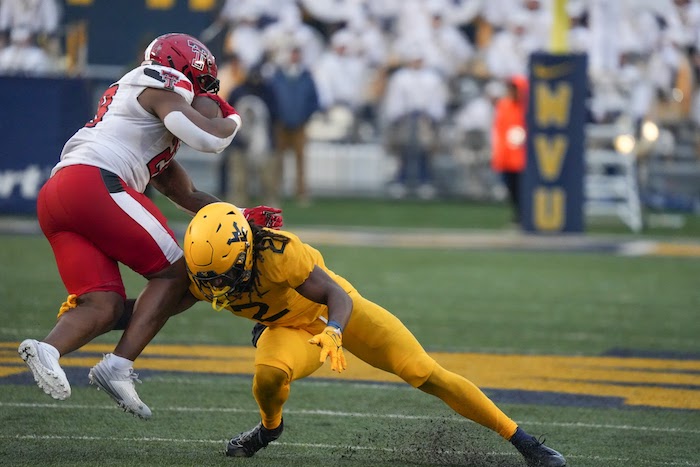
As ShaDon Brown takes charge as the first coach of West Virginia’s full secondary, he is becoming increasingly satisfied with the tools at his disposal.
Depth, while difficult to find in college football, comes in no shortage in WVU’s secondary. The main issue for Brown is finding where each player fits best.
“We’ve got a lot of talent,” Brown said. “Right now we’re trying to find the best five- the best five guys that go out there regardless of positions, so we’re mixing and matching a little bit and playing guys at multiple spots, which allows them to show some of their versatility and their skill set, and it also gives us an idea of what we can and what we can’t do.”
In Brown’s four seasons at WVU, this will be his first with a full cornerback room. Compared to the nine defensive backs available to him in his first year in 2021, Brown’s reported 16 players going for five positions is a lot to manage, but it is a problem Brown is happy to have.
Based on the depth chart released ahead of training camp, those five players looked to be senior Aubrey Burks at SPEAR, junior Duquesne transfer Ayden Garnes at left cornerback, senior Northwestern transfer Garnett Hollis Jr. at right cornerback, redshirt senior Anthony Wilson Jr. at free safety, and redshirt freshman Josiah Jackson at cat safety.
With three SPEARs, 10 safeties, and 11 cornerbacks listed on WVU’s roster, though, that exact look has plenty of room to change. For some players, their inclusion on the secondary may not change, but their position or role may.
“We’re just moving guys around based on packages and based on what we’re seeing from the offense, but it gives us a chance to create more depth and more value for each player because we’re seeing different things out of them in terms of having them play different spots,” Brown said.
As a whole, though, Brown is optimistic about his group’s potential.
“I see length, I see speed, we’re much bigger outside at corner than we have been, and we’ve got much more depth,” Brown said.
Several of these traits grew due in part to WVU’s 2024 transfer class. Transfers, as Brown says, provide an edge in terms of strength on the field that incoming freshmen simply have not had the game experience to build. One transfer in particular, Garnett Hollis Jr., earned Brown’s praise at training camp on Monday.
“(Hollis Jr.) doesn’t look like the prototype corner that we’ve had here, but he’s long, he can run, he can disrupt routes at the line of scrimmage, he gives us that big body where we can match up,” Brown said.
The flexibility given to Brown through Hollis’s size is something new to WVU’s secondary, which has most recently run through Pittsburgh Steelers undrafted rookie Beanie Bishop Jr. While, Bishop’s impact on WVU’s success last season was obvious, the new skillset of Hollis will be able to take the secondary to heights in areas it simply could not reach in 2023.
“At times last year, even as good as Beanie was, we would get pushed around a little bit. (Hollis Jr.) is so big and strong those plays don’t happen,” Brown said.
One area Hollis Jr. did struggle in entering the spring, Brown said, was in 50-50 ball situations in the air. According to Brown, Hollis Jr. saw WVU’s high-level production in that area last season and wanted to grow that skill, and now, just under a week into fall camp, he is showing flashes of the success he saw from Beanie Bishop Jr. last season.
Brown also expressed pleasure in the skill set of fellow transfer Ayden Garnes and returner Aubrey Burks, who Brown referred to as “slippery.”
With newfound talent, the new approach of safeties and corners operating under the same coach, and the mentality that Brown has helped build over the past three years, WVU’s defensive secondary will debut on Aug. 31 at home against Penn State.
Photo by Aaron Parker, Blue Gold Sports