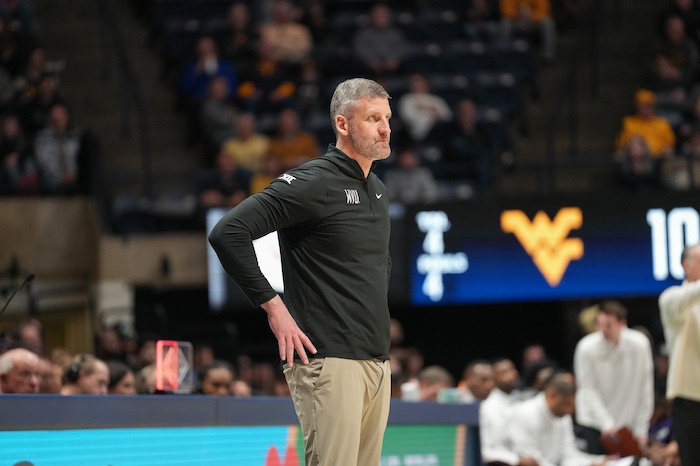
Representing one season, a 28 percent win rate, and more off-the-court controversy than in-game success, Josh Eilert’s WVU head coaching career may be one to forget on paper, but the remarkable stories it tells is bound to stand out in Mountaineer fans’ brains for years to come.
On Wednesday, March 13, West Virginia Director of Athletics Wren Baker officially announced his search for a new men’s basketball coach, and, as suddenly as it began, Josh Eilert’s time as head coach ended. The announcement came just one day after WVU’s loss to Cincinnati in the Big 12 Tournament, which capped off a 9-23 season that saw just four conference wins.
Eilert inherited the job from 16-year coaching veteran Bob Huggins, who resigned from the program after his second being charged with driving under the influence. One week after Huggins’ resignation, Eilert was named interim head coach for the upcoming season.
Huggins’ departure and Eilert’s appointment immediately established WVU as a team to watch in 2023-2024, especially in the realm of drama. Three key Mountaineers, in Joe Toussaint, Tre Mitchell, and Kerr Kriisa, entered the transfer portal immediately following Huggins’ removal from the team, with only Kriisa returning after Eilert’s appointment.
Aside from the coaching change, the Mountaineer roster looked very different from the prior season as well. Eight players made debuts for West Virginia during the season, and with all eyes on them, the Mountaineers struggled.
The lacking on-paper success for Eilert’s team came due to a variety of reasons, with the sheer competitive environment of the Big 12 being no exception to that. Nevertheless, WVU did not end the season where it wanted to, so Eilert was thanked for his time and cut, but the significance of his season continues to linger as its legacy begins to enter the history books.
WVU’s 2023-2024 men’s basketball season had ups and downs, but, aside from the coaching situation, a few storylines stand out as defining characteristics of the year and Josh Eilert’s head coaching career.
Transfer Portal Restrictions and Battling the NCAA in Court
One of the biggest storylines of the season for WVU happened not on the court, but in court. RaeQuan Battle, a fifth year transfer recruited in May, turned heads across the NCAA as he led the charge against the NCAA and its transfer rules.
Battle, a Washington native, spent two seasons at the University of Washington and two seasons at Montana State before transferring to West Virginia. Having not graduated, though, NCAA rules kept Battle ineligible from playing for one season. Battle requested a waiver and an appeal to bypass this rule on the basis of mental health, but the NCAA denied both.
With newly-allowed name, image, and likeness deals on the rise, the NCAA refused to believe that Battle would choose West Virginia for any reason unrelated to financial compensation. Upset, Battle took to Twitter, posting a video explaining his personal struggles and how they led him to Montana State and then West Virginia.
“The main thing with me being comfortable is having that coach,” Battle said in the video. “I kind of saw (Montana State coach Danny Sprinkle) as like a personal therapist.”
“I never wanted to leave Montana State, just good things happen to good people. Sprinkle was offered another job, and at Montana State it felt like it was me and him, and without him, that kind of forced me into entering the portal.”
Battle, who lost his close friend to a drug overdose a year prior, emphasized the importance of keeping basketball in his life and pushing to live up to his friend’s final words to him.
“The last words my best friend ever even said to me was, ‘You’re getting drafted,'” Battle said.
As for why Battle chose West Virginia, he cited an inability to focus at home in Washington due to the common usage of drugs and alcohol. In contrast, WVU provided Battle a comfortable sense of home, as Josh Eilert, like Battle, spent years of his childhood living in a Native American reservation.
Additionally, Battle cited WVU’s Rockefeller Neuroscience Institute as a leading force in improving his mental health. On those grounds, Battle took his case to court soon after his video’s release. The case quickly evolved to a seven-state lawsuit against the NCAA that sought a restraining order to the NCAA’s transfer rules.
On Dec. 13, that request was fulfilled, as the court initially issued a 14-day restraining order quickly followed by an extension of the order through the rest of the spring.
The ruling made an impact beyond the realm of just West Virginia, as multiple-time transfers across the NCAA were granted the ability to play. With Battle, this rule allowed WVU senior Noah Farrakhan to suit up for the first time in the season.
Battle’s fight quickly paid off for him on the court, as he burst onto the scene in the initial 14-day period to earn back-to-back Big 12 Player of the Week honors, averaging 27.3 points and 6.3 rebounds in his first three games. Battle finished the season as a starter in all 22 of his appearances, where he scored 16.1 points per game.
Adversity in Lacking Early-Season Depth
Partially due to the NCAA’s restrictions, Eilert and the Mountaineers lacked excess personnel in the player department to begin the season. Alongside Battle and Farrakhan, though, were transfers who were deemed eligible from the start.
Those players were, primarily, guard Kerr Kriisa and forward Akok Akok. Kriisa, who transferred to West Virginia after three years at Arizona, nearly left WVU before playing once but opted to stay with interim head coach Josh Eilert.
Despite his choice to stay, though, Kriisa’s WVU debut was put on hold anyways, as the NCAA suspended him for nine games due to his admitted reception of impermissible benefits at Arizona. Akok, meanwhile, was taken out of the lineup after experiencing a scary health emergency in a home exhibition game against George Mason.
With four key rotational players out of the lineup, therefore, the Mountaineers were forced into a tight lineup and difficulty distributing minutes in what should have been a calm start to non-conference play.
Josh Eilert primarily made use of a starting lineup of junior guard Kobe Johnson, freshman forward Ofri Naveh, sophomore forward Josiah Harris, and senior transfers Quinn Slazinski and Jesse Edwards. Junior Seth Wilson played a great deal of minutes as well, splitting guard duties with Johnson.
In the nine games before the return of Kriisa, West Virginia players outside of these six, namely senior Patrick Suemnick, redshirt freshman Jeremiah Bembry, and, for one game, Akok Akok, averaged a combined 13.2 minutes per game.
West Virginia’s lack of resources made the team 4-5 in those nine games and put its record at 5-8 once conference play began. Despite the odds against them, the Mountaineers continued to fight during this period, with team leader Quinn Slazinski making it very clear that they had no intention of making excuses based on their shortened depth.
“This is a high level. Forget the situation, we are here to play at a high level,” Slazinski said after WVU’s first loss of the season to Monmouth.
The players on the floor for West Virginia during this time certainly made that effort, which translated to greater success once players were made available.
Home Upsets of Texas and Kansas
Amidst controversy, availability concerns, and plenty of season struggles, the Mountaineers certainly managed to put a smile on fans’ faces in 2023-2024. This was best seen in their back-to-back home victories against ranked Big 12 opponents.
On Saturday, Jan. 13, the Mountaineers welcomed the No. 25 Texas Longhorns to the WVU Coliseum. Having just got out of the early-season depth issues, West Virginia found itself with a new absence in center Jesse Edwards. As such, Eilert opted to start 6’8″ Patrick Suemnick to fill the void, and with him was the three-guard lineup of Johnson, Kriisa, Battle, and Harris.
The Longhorns played a bit of a smaller lineup as well, as 6’9″ Dylan Disu stood as Texas’s tallest starter, but without Edwards, the Mountaineers certainly deviated from familiarity. Suemnick made that easy to forget, though, as he scored his then-season high of 16 points.
In doing so, the Mountaineers played efficiently along the perimeter, shooting 41.2 percent from three to score 21 points from outside. Kriisa led that charge, shooting four-for-eight from three. Defensively, WVU also forced 22 turnovers and grabbed 10 steals, thus keeping pace with Texas throughout.
The result was a close, but meaningful win for West Virginia. After a 30-28 WVU lead at halftime, both teams significantly raised their offensive production to finish with a 76-73 score in favor of the Mountaineers.
Battle and Kriisa each scored 14 points to go with Suemnick’s 16, and, in just 21 minutes off the bench, Quinn Slazinski scored 13 with seven-for-10 free throw shooting. The team scoring properly fought off a 32-point effort from Texas’s Max Abmas.
Exactly one week later, despite a painful away loss to Oklahoma in between, WVU made sure this victory was not a one-off fluke. Against the No. 3 Kansas Jayhawks, West Virginia started a nearly identical lineup, adding in only Akok Akok to gain some height in place of Josiah Harris.
Also identical were the biggest names contributing for the Mountaineers, though their impact was seen even more so against the Jayhawks. Suemnick posted another career high in points with 20, as he fought inside for eight-for-15 field goal shooting. Battle led the team in scoring this time, though, scoring 23 points with seven-for-14 field goal and three-for-seven three-point shooting.
Kriisa shot efficiently once again, this time making three of four three-pointers and ending with 15 points total. In fact, the Mountaineers as a team shot efficiently against Kansas, with Seth Wilson standing out with his three-for-three shooting from long range. WVU, as a team, finished 12-for-21 from three compared to Kansas’s seven-for-23 effort. In the first half alone, WVU shot nine-for-14 from three.
The lights-out three-point shooting put West Virginia over the edge, 91-85 against Kansas, and fans immediately rushed the court.
This energy signified the exact essence of Josh Eilert’s Mountaineers. The team had its struggles and had a lot of issues to work out, and not everything panned out as planned, but it was a team with potential and tremendous bright spots that the program will only look to build upon in the coming seasons with a new coach at the helm.
Photo by Aaron Parker, Blue Gold Sports