[et_pb_section fb_built=”1″ _builder_version=”4.17.4″ _module_preset=”default” global_colors_info=”{}”][et_pb_row _builder_version=”4.17.4″ _module_preset=”default” global_colors_info=”{}” custom_padding=”16px|||||” custom_margin=”-52px|auto||auto||”][et_pb_column type=”4_4″ _builder_version=”4.17.4″ _module_preset=”default” global_colors_info=”{}”][et_pb_text _builder_version=”4.17.4″ _module_preset=”default” global_colors_info=”{}”]
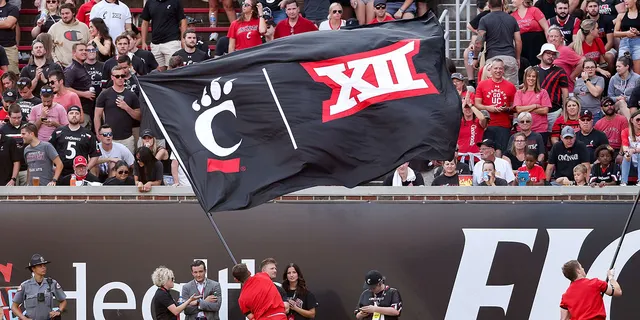
With the landscape of college athletics shifting drastically over the past year, the future of many conferences remains uncertain. However, the Big 12 will undoubtedly have four new members next year. Cincinnati, Houston, BYU, and UCF will join the Big 12 for the 2023-24 school year.
Possibly the most intriguing school out of the four is Cincinnati. Proving they belong in the national spotlight for football, the Bearcats were the first non-power five school to make the college football playoffs. Cincinnati’s success over the past several years is primarily due to their head coach Luke Fickell. During the 2018 and 2019 football seasons, Fickell lead the Bearcats to two 11-win campaigns, beating Virginia Tech and Boston College in their bowl games. However, Cincinnati finally put it all together in 2020 when they went 9 and 1 resulting in an American Athletic Championship. Ultimately, Luke Fickell and his team received invitations to play in a New Year’s Six Bowl, where they lost to Georgia on a last-second field goal.
Although 2018, 2019, and 2020 were all excellent seasons for Cincinnati, the Bearcats began turning heads when they beat Notre Dame in South Bend last year. Cincinnati finished the regular season undefeated, earning another American Athletic Championship, on the way to the college football playoff. In this spring’s NFL draft, several prominent names were also taken, including Ahmad “Sauce” Gardner, Desmond Ridder, and Coby Bryant.
While the football program is a national contender, Cincinnati’s basketball program is not something to take lightly. With the exception being last year, the Bearcats typically are at the top of the American Athletic Conference with Houston. Winning the American in 2018 and 2019, Cincinnati is also an annual contender in March Madness, making the tournament every season from 2011 to 2019.
Geographically, it is hard to miss the relationship between West Virginia and Cincinnati compared to the rest of the Big 12. Although the conference may eliminate the divisions, the Big 12 will still employ a model where one school plays the same three schools yearly. For example, West Virginia could play Cincinnati, UCF, and Iowa State every year. Due to the two school’s close proximity and the rest of the conference primarily out West, the Mountaineers could easily play Cincinnati every season.
Even though West Virginia might have a new rival to deal with annually, Cincinnati joining the Big 12 is ultimately helpful for the mountaineer faithful. The Bearcats’ programs provide the Big 12 with a winning culture and national exposure. With realignment and the future of college athletics uncertain, Cincinnati is one of the better schools the Big 12 could have brought in.
[/et_pb_text][/et_pb_column][/et_pb_row][/et_pb_section]