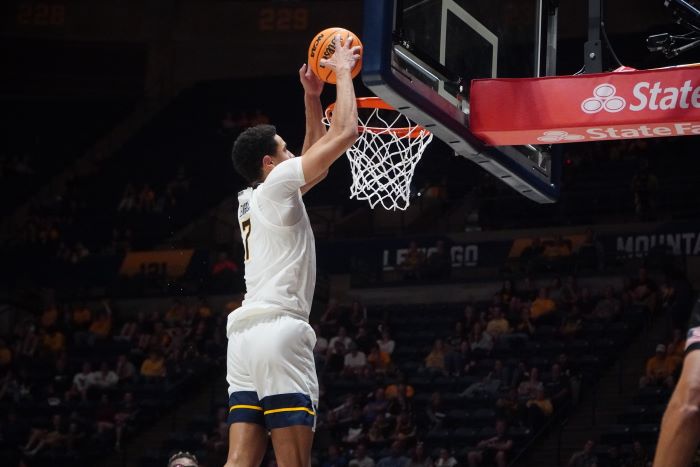
Jesse Edwards is a unique talent, especially in the realm of West Virginia basketball.
With guard-heavy play filling modern and old school Mountaineers history books, Edwards’ 6’11” frame and controlling yet slithery motion offensively is a breath of fresh air. That being said, the phenom does not come without legendary comparisons.
None of these players are, nor should they be, an exact replica of Edwards, and their legacies are impacted by longevity that Edwards will never have with WVU. As the Mountaineers forge a new path with him at the helm, though, it is good to look back at how other big men cemented their legacies and how his path compares.
Lloyd Sharrar (1955-1958)
Of the three comparisons, Sharrar is the closest to Edwards in terms of size. Standing at 6’10” and weighing in at 210 pounds, Sharrar’s build is far more reminiscent of modern centers than those in his era. His career averages in three years with WVU also stand very close to that of today’s players like Edwards, sitting at 12.5 points per game and 13.4 rebounds per game. His career highs in both categories, as well as his shooting percentage, occurred in his junior season, where he grabbed 14.8 rebounds per game and scored 16.1 points per game on 47.6% from the field and 63.6% from the free throw line. When compared to Jesse Edwards, the stats are remarkably similar, as Edwards currently posts 15.8 points per contest and grabs 10.7 boards on average. Box scores did not track players’ defensive contributions, such as steals and blocks, when Sharrar played.
While the numbers are similar, though, Sharrar’s come from a very different place than Edwards’ do. For one thing, rebounding statistics were heavily inflated during Sharrar’s era. Elgin Baylor, who led the NCAA in rebounds in 1957, averaged 20.3 rebounds per game, which was not entirely uncommon for college big men at the time. Nowadays, the 14.8 rebounds per game Sharrar recorded stand a full rebound per game ahead of Kentucky’s Oscar Tshiebwe, who led the league in rebounding last season. As such it is difficult to compare Sharrar’s rebounding contribution to that of Edwards’ due to the eras being significantly different.
Additionally, while Edwards appears as the Mountaineers’ leader this year, Lloyd Sharrar had the luxury of playing alongside Hot Rod Hundley and Jerry West on possibly the best West Virginia teams in the school’s men’s basketball history. His contributions, both in rebounding and scoring, were significant to the team’s success, but he simply plays a very different role from the one Edwards has taken on. Overall, though, Lloyd Sharrar’s essence can certainly be found within Jesse Edwards, as the two share similar builds and had similar scoring and rebounding numbers in their respective eras. Edwards’ size makes him a consistent threat that no other Mountaineer can provide on that front, which was exactly what Sharrar’s size did for his guard-led team.
Kevin Jones (2008-2012)
Unlike Sharrar, Jones played in an era that may be directly comparable to that of Edwards’ today. With that in mind, the two players are a perfect match.
In Jones’ senior season, he averaged 19.9 points per game, 10.9 rebounds per game, 1.2 assists per game, and one block per game. Compared to Edwards’ 15.8 points, 10.7 rebounds, 1.3 assists, and two blocks on average, the players seemed to lead their teams very similarly. Like Edwards, Jones entered his final season with plenty of playoff experience under his belt, though his Final Four run as a sophomore was a bit of a higher stage than Edwards ever reached at Syracuse.
Overall, though, both players held down the post in similar ways and scored at similar frequencies and in similar ways. They both took on a leadership role offensively in their final season, and hopefully they end with similar success. In the realms of differences, though, Jones really lived as a power forward rather than as WVU’s sole threat inside in the way Edwards has. He stood a bit shorter, at 6’8″, when compared to Edwards’ 6’11” stature, and, as such, he could not afford to live in the post as much as Edwards will likely continue to this season. Jones did not shoot a lot of threes, averaging just under four attempts per game in his senior year, but even at just a clip of 26.6%, that seems to be a weapon in Jones’ arsenal that Edwards just does not have or does not use in the same way. Nevertheless, the comparison stands, especially where per game averages in a modern day NCAA are concerned.
Mark Workman (1949-1952)
For Edwards’ last comparison, he taps into a true West Virginia legend, 6’9″ Mark Workman. Workman was the first of two WVU players to be drafted first overall in the NBA, as he was selected by the Milwaukee Hawks in 1952. He played three seasons in the NBA.
For West Virginia, Workman was a machine. Not only did he hold down the post better than many big men in the league at the time, averaging 17.5 rebounds per game in the only season it was recorded, he was the primary offensive force for the Mountaineers. After averaging 10.4 points per game in his first season, Workman stepped up to 26.1 points per game in 1951 and 23.1 points per game in 1952. In his senior season, he led the Mountaineers to a 23-4 record, good enough for No. 9 in the AP poll. Similarly, Edwards started out as a bench role player at Syracuse, averaging about two points per game in both his freshman and sophomore seasons. In his junior year, though, he was asked to step up offensively, and he did, rising to 12 points per game and now to the 15.8 average he holds with West Virginia.
Like Edwards, Workman left a lot of points on the board, as he shot just 48% from the field in each of his junior and senior year, but the positive aspect of this was obviously his ability to control offensive rebounds and get his scoring in regardless. Edwards has had some struggles finishing at the rim so far this season, even though he shoots 54.1% from the field so far, so a commanding presence inside similar to Workman’s would really benefit him. This dominance is not unreachable for Edwards by any means, either, as his 6’11” height and 240 pound body gives him the physicality advantage Workman had in the 1950s.
Jesse Edwards is not slated to be drafted first overall in the NBA, but the comparison to the legendary Mark Workman stands regardless, as both players have a size advantage that can control both sides of the floor. Both made themselves significant offensive threats at a point in their careers when it was necessary, and they stand for what the team’s goals and capabilities are. If Edwards leans into this comparison and truly leads the Mountaineers this season, his one season at WVU will be one to remember.
Photo by Wesley Shoemaker, Blue Gold Sports